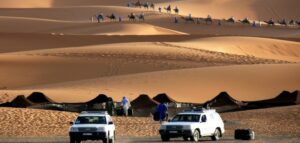
🏜️ Desert Safaris – Explore the Sahara & White Desert by 4×4 or Camelback
Discover Egypt beyond the pyramids with 4×4 desert adventures, camel treks, surreal White Desert landscapes, remote oases, desert camping, brilliant sunsets, and unforgettable nights beneath the stars.
Thank you for reading this post, don't forget to subscribe!Egypt may be famous for the Pyramids of Giza, ancient temples, the Nile River, and Red Sea, but beyond these legendary attractions lies another extraordinary side of the country — the vast Egyptian desert.
Travel west from the Nile Valley and the landscape opens into enormous horizons filled with golden sand, rugged mountains, volcanic terrain, remote oases, and bizarre white rock formations sculpted by wind and time.
A desert safari gives travelers the opportunity to leave Egypt’s busy cities behind and experience landscapes that can feel almost untouched.
Whether racing across desert tracks in a 4×4, traveling slowly across the sand by camelback, photographing unusual geological formations, exploring palm-filled oases, or camping beneath an enormous night sky, Egypt’s deserts offer one of the country’s greatest outdoor adventures.
Thank you for reading this post, don’t forget to subscribe!
🎥 Watch the Egypt Desert Safari Adventure
Experience the incredible landscapes of Egypt’s Sahara and White Desert through this visual journey across golden dunes, rugged desert terrain, remote oases, and spectacular wind-carved rock formations.
Travel by 4×4 and camelback, explore the Black and White Deserts, discover Bedouin-style desert camps, and watch the landscape transform through brilliant sunsets, star-filled skies, and desert sunrises.
▶️ Watch: Egypt Desert Safari Adventure | Sahara & White Desert by 4×4 & Camel
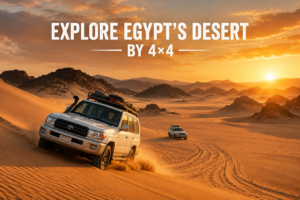
🚙 Explore Egypt’s Desert by 4×4
For travelers looking to cover larger distances, a 4×4 desert safari is one of the most exciting ways to explore Egypt’s remote landscapes.
Specialized desert vehicles can travel across terrain that ordinary vehicles cannot easily reach, opening access to dunes, rocky plateaus, remote valleys, desert formations, and isolated camps.
Depending on the itinerary, a 4×4 adventure may include:
- Driving across open desert landscapes
- Crossing sandy tracks and dunes
- Visiting remote oases
- Exploring the Black Desert
- Discovering the White Desert
- Stopping at unusual geological formations
- Watching the desert sunset
- Visiting natural springs
- Camping overnight
- Stargazing far from city lights
The journey itself becomes part of the adventure.
One moment you may be crossing an enormous empty plain, and the next you may arrive at a strange rock formation, oasis, or desert mountain rising from the horizon.
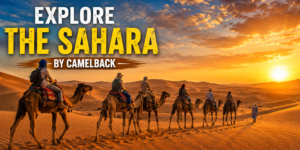
🐪 Explore the Sahara by Camelback
For a completely different experience, travelers can explore portions of Egypt’s desert by camelback.
Camel trekking moves at a much slower pace than traveling by 4×4.
Instead of covering large distances quickly, the experience allows you to absorb the silence and scale of the surrounding desert.
The rhythmic movement of the camel, enormous open horizon, and absence of busy roads create an atmosphere unlike Egypt’s major tourist destinations.
Camel excursions can range from shorter rides to longer journeys incorporated into organized desert adventures.
For photographers, camel caravans crossing dunes can also create some of the most recognizable images of desert travel.

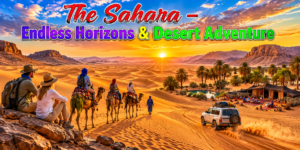
🏜️ The Sahara – Endless Horizons & Desert Adventure
The Sahara Desert stretches across much of North Africa and dominates an enormous portion of Egypt’s western landscape.
Rather than being one endless field of sand dunes, the Egyptian desert contains a remarkable variety of environments.
Travelers may encounter:
- Sand dunes
- Rocky plateaus
- Desert mountains
- Dry valleys
- Natural springs
- Oases
- Volcanic-looking terrain
- Chalk formations
- Open gravel plains
- Remote settlements
The enormous scale is one of the first things visitors notice.
With few buildings, roads, or trees blocking the view, the horizon can seem almost endless.
It is an incredible contrast to the crowded streets of Cairo or the green agricultural landscapes bordering the Nile.
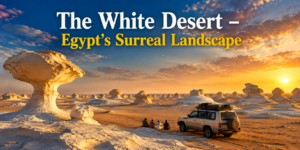
🤍 The White Desert – Egypt’s Surreal Landscape
One of the most extraordinary desert environments in Egypt is the White Desert, also known as Sahara el Beyda.
The landscape is famous for brilliant white chalk and limestone formations shaped over long periods by erosion.
Wind and blowing sand have gradually transformed the rock into unusual natural sculptures.
Some formations resemble:
- Giant mushrooms
- Towers
- Animals
- Icebergs
- Domes
- Pillars
- Abstract sculptures
Against the surrounding desert, the bright formations can create an almost extraterrestrial landscape.
Walking among them can feel more like exploring another planet than traveling through Egypt.

🌅 Sunset in the White Desert
Late afternoon can be one of the most spectacular times to experience the White Desert.
As the sun moves toward the horizon, the intense daytime light softens.
White formations begin reflecting shades of gold, pink, orange, and red, while long shadows stretch across the desert floor.
The formations that looked brilliant white during the afternoon can appear completely different only a few hours later.
For photographers, sunset provides opportunities to capture dramatic silhouettes and colorful desert landscapes.
Then the sun disappears.
And another desert experience begins.
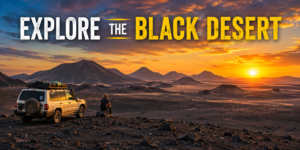
🌑 Explore the Black Desert
The nearby Black Desert creates an extraordinary contrast with the White Desert.
Instead of brilliant white formations, the landscape contains dark hills and mountains covered with black volcanic-looking material.
The combination of dark peaks, golden desert floor, and enormous blue sky creates another distinctive Egyptian landscape.
Travelers exploring this region often combine several desert environments during the same journey, making the dramatic changes in scenery part of the experience.
One day can include palm-filled oases, dark mountains, golden sand, and brilliant white rock formations.
Few destinations offer that much visual variety within a single desert adventure.
🌴 The Magic of Egypt’s Desert Oases
After traveling through miles of dry desert, suddenly seeing palm trees and vegetation can seem almost impossible.
Yet Egypt’s Western Desert contains several famous oasis regions, including:
- Bahariya Oasis
- Siwa Oasis
- Farafra Oasis
- Dakhla Oasis
- Kharga Oasis
Each has its own landscapes, communities, history, and traditions.
Oases have supported communities and travelers for generations by providing precious sources of water within otherwise extremely dry environments.
Today, some travelers build entire itineraries around Egypt’s oasis regions rather than treating them simply as stops along the way.
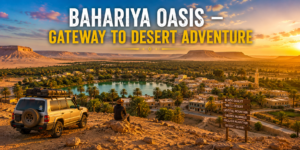
🌴 Bahariya Oasis – Gateway to Desert Adventure
Bahariya Oasis is particularly important for travelers heading toward the Black Desert and White Desert.
The oasis provides a dramatic change from the surrounding barren terrain.
Palm trees, cultivated areas, settlements, and natural springs create patches of green surrounded by enormous desert landscapes.
Many organized desert excursions use the oasis region as a starting point before continuing deeper into the Western Desert.
For travelers beginning in Cairo, reaching the oasis also provides a fascinating transition from one of Africa’s largest cities into increasingly remote desert country.
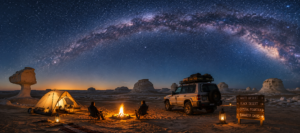
🔥 Desert Camping Beneath the Stars
Spending a night in the Egyptian desert can completely change the experience.
During daylight hours, the desert may feel enormous, bright, hot, and exposed.
Once the sun disappears, temperatures begin falling and the landscape becomes remarkably quiet.
Many organized overnight excursions establish camps where travelers can relax, enjoy dinner, drink tea, and watch the stars emerge.
Depending on the excursion, accommodations may range from simple sleeping arrangements to tents and more organized desert camps.
The experience isn’t necessarily about luxury.
It is about waking up surrounded by one of the most extraordinary landscapes in Egypt.
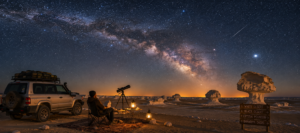
🌌 Stargazing in the Egyptian Desert
Far from Cairo and other heavily populated areas, remote desert regions can offer impressive opportunities for stargazing.
With limited artificial lighting, dark skies can reveal enormous numbers of stars.
On particularly clear nights, travelers may even see the Milky Way stretching across the sky.
The landscape creates an incredible foreground for nighttime photography.
Imagine photographing:
- White Desert formations beneath the stars
- Camels silhouetted against the night sky
- Tents glowing beneath the Milky Way
- Desert mountains beneath thousands of stars
- A campfire surrounded by complete darkness
For travelers interested in astronomy or photography, an overnight safari provides an experience that a daytime desert excursion simply cannot match.
🌅 Desert Sunrise & Sunset
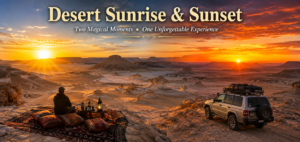
Few landscapes display changing light as dramatically as the desert.
During the middle of the day, strong sunlight can flatten colors and create intense brightness.
Near sunrise and sunset, everything changes.
Sand dunes become golden.
Long shadows reveal patterns across the desert floor.
White rock formations turn pink and orange.
Mountains become dark silhouettes against the horizon.
These periods can provide spectacular conditions for landscape photography.
Even without a camera, sitting quietly and watching the sun disappear beyond the desert horizon can become one of the highlights of the journey.
📸 Desert Photography

Egypt’s deserts provide nearly endless opportunities for photography.
Some subjects worth watching for include:
- Camel caravans
- 4×4 vehicles crossing desert terrain
- White Desert formations
- Black Desert mountains
- Palm-filled oases
- Desert camps
- Sunrise and sunset
- Star-filled skies
- Traditional camps
- Natural rock formations
- Wind-created patterns in the sand
- People silhouetted against the horizon
Early morning and late afternoon generally create softer light and stronger shadows than the intense midday sun.
Sand and dust can also be hard on cameras and phones, so protect electronics carefully during windy conditions.
🦂 Wildlife of Egypt’s Desert
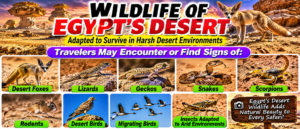
Although the desert can initially appear empty, wildlife has adapted to survive in these harsh environments.
Depending on the location, travelers may encounter or find signs of:
- Desert foxes
- Lizards
- Geckos
- Snakes
- Scorpions
- Rodents
- Desert birds
- Migrating birds
- Insects adapted to arid environments
Many desert animals avoid the hottest part of the day and become more active around sunset or at night.
Wildlife should always be observed from a respectful distance.
Avoid reaching underneath rocks, entering animal burrows, or handling unfamiliar desert creatures.
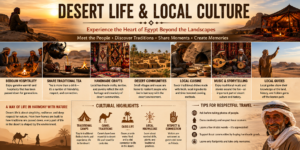
🐪 Desert Life & Local Culture
Egypt’s desert isn’t simply empty wilderness.
Communities have lived around its deserts and oases for generations, developing traditions and ways of life adapted to extremely dry environments.
Some organized excursions may introduce travelers to local food, tea, music, storytelling, crafts, and hospitality.
These experiences can add another dimension to a desert journey beyond sightseeing and photography.
Travelers should approach cultural experiences respectfully and remember that communities encountered during a safari are people’s homes and livelihoods, not simply tourist attractions.
🥘 Food & Tea in the Desert
A simple meal can feel completely different when eaten beneath an open desert sky.
Depending on the safari, meals may be prepared at camp and accompanied by traditional tea.
After traveling all day through sand, rock, and rugged landscapes, sitting around camp and enjoying a warm meal can become one of the most relaxing parts of the experience.
Travelers with dietary requirements or allergies should communicate them to the tour operator before leaving, especially when traveling into remote areas where alternatives may be limited.
☀️ Best Time for an Egypt Desert Safari

Egypt’s desert can experience extreme temperatures, making the season an important consideration when planning an adventure.
Generally, the cooler months are more comfortable for desert exploration than the hottest part of summer.
Winter days can be pleasantly warm, while nighttime temperatures may become surprisingly cold.
Spring and autumn can also provide comfortable conditions, although weather varies.
Summer temperatures can become extremely intense, particularly around midday.
Regardless of the season, prepare for:
- Strong sunlight
- Dry air
- Hot daytime conditions
- Cooler nighttime temperatures
- Wind and blowing sand
- Significant temperature changes
Always check current local weather and desert conditions before departing.
🎒 What to Bring on an Egypt Desert Safari

Proper preparation can make a desert excursion much more enjoyable.
Consider bringing:
- Plenty of drinking water
- Sunscreen
- Sunglasses
- Wide-brimmed hat
- Lightweight breathable clothing
- Warmer layer for nighttime
- Comfortable closed-toe footwear
- Small backpack
- Camera or smartphone
- Portable power bank
- Personal medications
- Lip balm
- Moisturizer
- Hand sanitizer
- Small first-aid kit
- Headlamp or flashlight
- Reusable water bottle
- Protection from dust for cameras and electronics
Avoid packing excessively for short excursions, but don’t underestimate how quickly desert conditions can change.
🥾 Footwear & Clothing for Desert Adventures
Footwear becomes particularly important when walking across loose sand, rocky surfaces, and uneven desert terrain.
Comfortable closed-toe walking or hiking shoes generally provide better protection than sandals when exploring rugged areas.
Lightweight clothing can help during hot daytime conditions, while long sleeves and trousers provide additional protection from sunlight.
For overnight excursions, bring a warmer layer.
Desert temperatures can fall significantly after sunset.
A scarf or lightweight face covering can also be useful when wind carries sand or dust through the air.
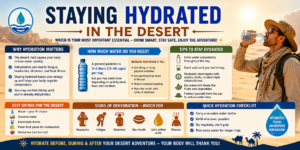
💧 Staying Hydrated in the Desert
Hydration is extremely important in Egypt’s dry climate.
Travelers can lose significant amounts of water without immediately noticing because perspiration may evaporate quickly in hot, dry air.
Drink water regularly instead of waiting until you feel extremely thirsty.
For longer excursions, confirm that your tour provider carries adequate drinking water and emergency supplies.
Water should remain the priority during desert activities.
🧭 Travel with Experienced Desert Guides
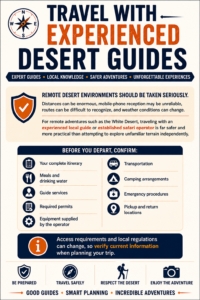
Remote desert environments should be taken seriously.
Distances can be enormous, mobile-phone reception may be unreliable, routes can be difficult to recognize, and weather conditions can change.
For remote adventures such as the White Desert, traveling with an experienced local guide or established safari operator is far safer and more practical than attempting to explore unfamiliar terrain independently.
Before departing, confirm:
- Your complete itinerary
- Transportation
- Meals and drinking water
- Camping arrangements
- Guide services
- Emergency procedures
- Required permits
- Pickup and return locations
- Equipment supplied by the operator
Access requirements and local regulations can change, so verify current information when planning your trip.
🏨 Where to Stay Before or After Your Desert

Safari
Many travelers begin their desert adventure after spending time in Cairo or near an oasis such as Bahariya.
Staying in Cairo before or after the safari provides additional time to explore the:
- Pyramids of Giza
- Great Sphinx
- Museums
- Historic mosques
- Markets
- Nile River
- Restaurants and city attractions
Travelers planning longer Western Desert journeys may instead choose accommodations closer to oasis regions depending on their itinerary.
👉 Book Your Stay in Cairo, Egypt
A comfortable hotel night can be especially welcome after spending several days exploring the desert.
🏛️ Combine a Desert Safari With Ancient

Egypt
One of the greatest advantages of visiting Egypt is the ability to combine completely different adventures during a single vacation.
You could spend one day walking through a temple constructed thousands of years ago and another traveling across an enormous desert wilderness.
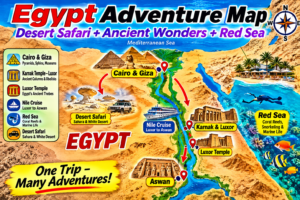
Explore Cairo & Giza
Visit the Pyramids of Giza, Great Sphinx, museums, markets, historic mosques, and Nile River.
Explore Karnak Temple – Luxor
Walk among colossal columns, ancient pylons, statues, obelisks, and hieroglyph-covered walls at one of Egypt’s greatest temple complexes.
Explore Luxor Temple
Discover monumental statues, ancient columns, the Avenue of Sphinxes, and thousands of years of Egyptian history.
Cruise the Nile From Luxor to Aswan
Travel between ancient temples, riverside communities, palm-covered landscapes, and desert scenery aboard one of Egypt’s classic Nile journeys.
Explore the Red Sea
Swap desert sand for brilliant turquoise water, coral reefs, snorkeling, scuba diving, beaches, marine life, and coastal adventures.
🗺️ Egypt Desert Safari Route Ideas
A desert safari can fit into a larger Egypt itinerary in several ways.
One possible adventure could follow:
Cairo & Giza → Bahariya Oasis → Black Desert → White Desert → Cairo
Travelers with more time could build a much larger Egyptian adventure:
Cairo → Western Desert → Luxor → Nile Cruise → Aswan → Red Sea
That itinerary demonstrates just how varied Egypt can be.
During a single vacation, travelers can experience pyramids, temples, cities, rivers, deserts, oases, coral reefs, beaches, and archaeological sites.
🌍 Responsible Desert Travel
Desert environments can appear rugged and indestructible, but many formations and ecosystems are surprisingly fragile.
Help protect them by:
- Taking all trash with you
- Avoiding damage to rock formations
- Staying on established routes where required
- Respecting wildlife
- Avoiding removal of rocks, fossils, or natural objects
- Using established campsites when available
- Respecting local communities
- Following instructions from guides and protected-area staff
Responsible tourism helps preserve Egypt’s extraordinary desert landscapes for future travelers.
⭐ Why Take a Desert Safari in Egypt?
A desert safari reveals an entirely different side of Egypt.
Beyond the famous pyramids and temples lies a wilderness filled with dramatic geological formations, remote oases, enormous horizons, brilliant sunsets, star-filled skies, and genuine outdoor adventure.
Travelers can cross rugged landscapes by 4×4, experience the slower rhythm of camel trekking, photograph surreal White Desert formations, explore contrasting desert environments, and camp beneath the stars.
For anyone building an Egypt itinerary around history, nature, photography, culture, and adventure, the desert deserves a place on the journey.
Egypt’s greatest adventures don’t end at the Nile — sometimes they begin where the road disappears into the desert.
👉 Continue Exploring Egypt
Discover more pyramids, temples, Nile adventures, ancient cities, desert landscapes, beaches, and outdoor experiences throughout Egypt.
👉 Continue Exploring Egypt and More Outdoor Adventures
👉 Visit the Ultimate Outdoor Adventure Mega Hub
Thank you for visiting MyCampingVacationSites! I hope this guide helps you plan an unforgettable outdoor adventure. If you enjoyed this article, feel free to leave a comment below and explore more travel guides, hiking destinations, camping adventures, and outdoor experiences throughout the site. Have a wonderful vacation wherever your next journey takes you!
— Jeffrey
 Explore More Hubs
 Water Adventure Gear
 50 Must-Have Water Adventure Items (Complete Gear Guide) Ultimate Jet Ski Gear & Accessories Guide
  (Top Picks for Speed & Fun) Best River Rafts & Floating Docks
  (Rafting & Floating Essentials)
 Camping & Tent Gear
Tents: Best Tents for Camping & Outdoor Adventures (Top-Rated Picks) Ultimate Glamping Gear: 50 Must-Have Tents & Adventure Essentials  (Luxury Setup Guide)
 RV & Camper Gear
RV Adventure Gear: Must-Have Essentials for Road Trips & Camping (Full Travel Setup) Ultimate Interior RV & Camper Gear Guide  (Comfort & Living Upgrades)
Leave a Reply