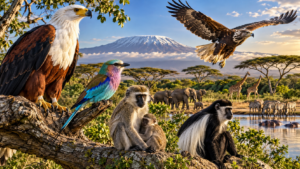
Africa’s safari landscapes are famous for lions, elephants, giraffes, rhinos, and other large mammals, but some of the continent’s most memorable wildlife experiences happen above the ground.
Thank you for reading this post, don't forget to subscribe!Eagles circle high over open savannas. Brilliantly colored birds gather around rivers and wetlands. Hornbills move through woodland trees, while monkeys leap between branches in tropical forests.
From the vast plains of East Africa to the waterways of Southern Africa and the rainforests of West and Central Africa, birds and primates add another dimension to an African safari.
Whether you are traveling by safari vehicle, boat, on foot, or even viewing the landscape from the air, there are opportunities to discover wildlife everywhere you look.
This guide explores some of Africa’s remarkable birds, eagles, monkeys, and primates, along with where to see them, photography tips, the best safari environments, and ideas for combining these encounters with a larger African adventure.
Why Birds & Monkeys Belong on an African Safari
Large mammals may receive most of the attention, but focusing only on them means overlooking an enormous part of Africa’s wildlife.

Birds can be found in virtually every safari environment, including:
- Savannas
- Rainforests
- Rivers
- Lakes
- Wetlands
- Mountains
- Coastal areas
- Desert regions
- Woodland
- National parks and reserves
Primates add another experience entirely.
Monkeys and other primates can be highly active, social, and entertaining to observe. Some remain high in the forest canopy, while others can sometimes be encountered near rivers, woodland edges, trails, or open forest clearings.
Together, birds and primates can turn the quiet periods between sightings of Africa’s larger animals into some of the most interesting moments of a safari.
Eagles of Africa
Few sights represent wilderness better than a large eagle soaring over an African landscape.
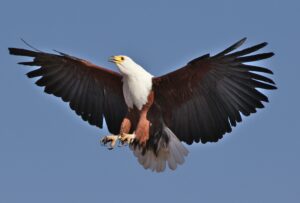
Africa supports an impressive variety of eagles occupying habitats ranging from rivers and lakes to forests, mountains, and open savannas.
African Fish Eagle
The African fish eagle is one of Africa’s most recognizable birds of prey.
Adults have a striking appearance with a mostly white head and chest contrasting against a darker body and powerful wings.
They are strongly associated with water and may be encountered around:
- Large lakes
- Rivers
- Wetlands
- Reservoirs
- Lagoons
Travelers exploring places such as the Chobe River, Okavango Delta, Nile waterways, Rift Valley lakes, and other major African water systems may have opportunities to spot fish eagles perched high above the shoreline.
Boat safaris can be particularly rewarding because they allow travelers to watch the riverbanks and trees from the water.
Martial Eagle
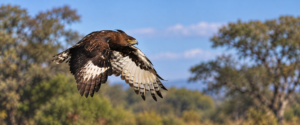
The martial eagle is among Africa’s largest and most powerful eagles.
It favors expansive landscapes where it can search for prey from above.
Savanna safari destinations in East and Southern Africa provide opportunities to encounter these impressive raptors.
Rather than watching only the grass for lions and antelope, occasionally look toward isolated trees and high into the sky.
A distant shape perched above the plains may turn out to be one of Africa’s great eagles.
Crowned Eagle
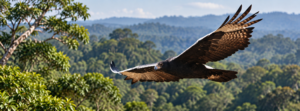
Forest environments offer a completely different eagle experience.
The crowned eagle is strongly associated with wooded and forested habitats in parts of sub-Saharan Africa.
Its powerful build makes it particularly well suited to hunting within forest environments.
Finding one can require patience because dense vegetation makes wildlife considerably harder to locate than on an open savanna.
That challenge is also part of the experience.
Snake Eagles
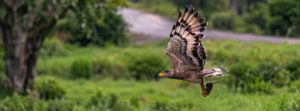
Several snake eagle species occur across Africa.
These birds of prey are adapted to hunting reptiles and other animals in open woodland and savanna environments.
Safari travelers may notice them perched on exposed branches where they have an excellent view of the surrounding terrain.
A pair of binoculars can make distant raptor identification much easier.
Spectacular African Safari Birds
Eagles are only the beginning.
Africa’s national parks and wilderness areas contain an extraordinary variety of birds ranging from tiny, brilliantly colored species to enormous ground-dwelling birds.
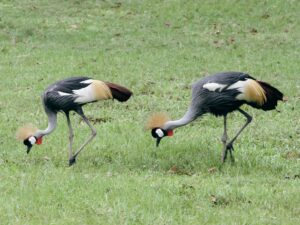
Grey Crowned Crane
The grey crowned crane is one of Africa’s most distinctive birds.
Its golden crown of feathers immediately makes it recognizable.
Wetlands, grasslands, and areas near water can provide excellent environments for seeing cranes and many other water-associated species.
They are particularly associated with parts of eastern and southern Africa.
Lilac-Breasted Roller
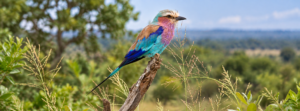
Few safari birds attract photographers as quickly as the lilac-breasted roller.
Its combination of blue, turquoise, green, violet, and other colors makes it spectacular against the browns and greens of the African landscape.
These birds may perch prominently on branches or other elevated positions, making them excellent photographic subjects.
For travelers interested in wildlife photography, even a short sighting can produce some of the most colorful images of an entire safari.
African Grey Parrot
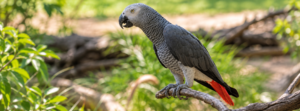
Move westward into the tropical forests of Central and West Africa and the birdlife changes dramatically.
The African grey parrot is associated with forest environments in this part of the continent.
Its mostly grey plumage may appear understated compared with some brightly colored tropical birds, but its intelligence and social behavior have made it one of Africa’s best-known parrots.
Observing parrots flying freely through their natural forest habitat is very different from seeing them in captivity.
Hornbills
Hornbills are another unforgettable part of African birdlife.
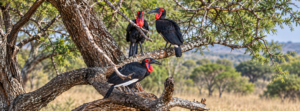
Different species inhabit forests, woodland, and savanna environments.
Their distinctive bills and sometimes noisy behavior can make them easier to notice than smaller forest birds.
Depending on the destination, travelers may encounter hornbills while:
- Driving through woodland
- Walking forest trails
- Exploring river corridors
- Watching wildlife around camp
Ostriches

The ostrich takes African birdwatching to an entirely different scale.
As the world’s largest living bird, an ostrich walking across an open African landscape is difficult to overlook.
Their long legs allow them to cover ground remarkably quickly, and their enormous size creates fantastic photographic opportunities when they appear against an open savanna.
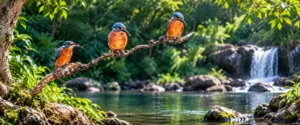
Kingfishers
African rivers and wetlands can support several species of kingfishers.
Some are brilliantly colored, while others have striking black-and-white patterns.
River safaris provide an excellent opportunity to slow down and watch branches hanging over the water.
A small bird sitting motionless above the river may suddenly dive toward the surface in search of prey.
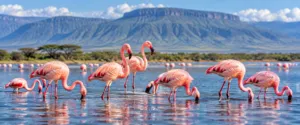
Flamingos & Rift Valley Lakes
Some East African lakes can produce spectacular concentrations of waterbirds, including flamingos when environmental and feeding conditions are favorable.
The combination of water, mountains, open skies, and large numbers of birds can create an entirely different safari landscape from the traditional grassland experience.
Bird activity can change seasonally and with local water conditions, so sightings should never be considered guaranteed.
Monkeys of Africa
Africa’s monkeys are just as diverse as its landscapes.
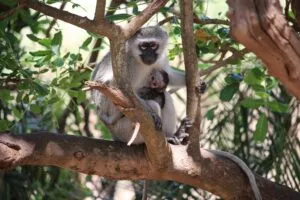
Some species spend much of their time high in rainforest trees, while others regularly travel on the ground.
Their social behavior makes them fascinating to observe.
Vervet Monkeys
Vervet monkeys occur across large portions of sub-Saharan Africa and can be encountered in numerous safari destinations.
They often live in social groups and may spend time both in trees and on the ground.
Travelers should never feed wild monkeys.
Feeding can change natural behavior, encourage animals to approach people, and create problems for both wildlife and visitors.
Colobus Monkeys
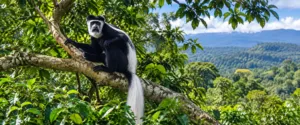
Colobus monkeys are particularly striking.
Some species have dramatic black-and-white coats that stand out against green forest vegetation.
They spend considerable time in trees, where their movements through the canopy can be impressive to watch.
Forest walks can provide a very different primate experience from viewing wildlife from a safari vehicle.
Instead of scanning a distant horizon, you may find yourself looking directly upward into the branches.
Blue Monkeys
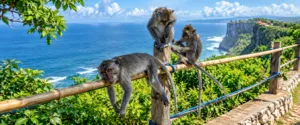
Despite their name, blue monkeys are not bright blue.
They occur in forested regions of Africa and are another primate travelers may encounter while exploring suitable woodland and rainforest habitats.
Dense forests require a different approach to wildlife observation.
Listening can be just as important as looking.
Moving branches, calls from the canopy, or sudden activity overhead may reveal animals that were previously invisible.
Red Colobus Monkeys
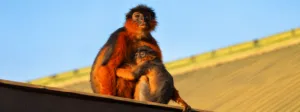
Several forms of red colobus occur in parts of Africa, with different populations associated with particular regions and forest habitats.
Their restricted distributions make protecting remaining forests especially important.
Travelers interested in primates may want to include specialized forest destinations rather than concentrating exclusively on traditional savanna parks.
Beyond Monkeys — Africa’s Great Apes
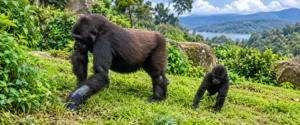
A bird and monkey safari can also connect naturally with Africa’s extraordinary great apes.
Gorillas
Gorilla trekking provides one of Africa’s most specialized wildlife adventures.
Destinations in Uganda and Rwanda are famous for mountain gorilla trekking, while parts of Central Africa are home to western lowland gorillas.
A gorilla trek can complement a broader wildlife itinerary that includes birds, monkeys, ground safaris, and river adventures.
Explore African Gorilla Trekking & Wildlife Adventures
Chimpanzees
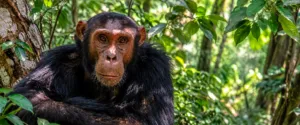
Chimpanzees provide another remarkable primate experience.
Unlike a traditional vehicle safari, chimpanzee trekking usually involves entering forest environments with trained guides and listening carefully for movement and vocalizations.
Chimpanzees can move quickly through trees and across the forest floor, creating a much more active wildlife encounter.
East Africa — Birds, Eagles & Primates
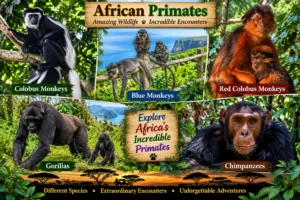
East Africa offers an excellent combination of open savanna, mountains, forests, wetlands, rivers, and lakes.
Countries such as Kenya, Tanzania, Uganda, and Rwanda can provide opportunities to combine traditional wildlife viewing with birdwatching and primate adventures.
Possible experiences include:
- Eagles soaring over savannas
- Rollers and hornbills along game-drive routes
- Waterbirds around lakes
- Fish eagles near rivers
- Monkeys in forest environments
- Chimpanzee trekking
- Gorilla trekking
- Flamingos in suitable lake environments
This diversity makes East Africa particularly attractive for travelers who want much more than the traditional Big Five experience.
Southern Africa — Rivers, Raptors & Monkeys
Southern Africa offers another enormous range of environments.
Destinations in South Africa, Botswana, Namibia, and Zimbabwe can combine birds and primates with some of Africa’s best-known safari landscapes.
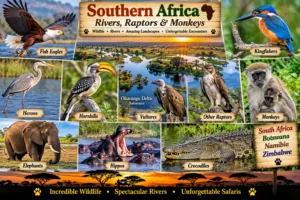
The Okavango Delta and Chobe River region can be particularly rewarding for bird enthusiasts because water, islands, woodland, and floodplains create numerous wildlife habitats.
A single day might include:
- Fish eagles
- Kingfishers
- Herons
- Hornbills
- Vultures
- Other raptors
- Monkeys
- Elephants
- Hippos
- Crocodiles
That variety is one reason river and ground safaris work so well together.
West & Central Africa — Rainforest Wildlife
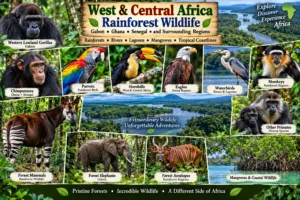
West and Central Africa provide a dramatically different safari environment.
Instead of endless open plains, many adventures lead into rainforests, river systems, lagoons, mangroves, and tropical coastlines.
Destinations in Gabon, Ghana, Senegal, and surrounding regions can offer opportunities to discover:
- Tropical forest birds
- Parrots
- Hornbills
- Eagles
- Waterbirds
- Monkeys
- Other primates
- Forest mammals
Gabon can be especially interesting for travelers wanting to combine rainforest wildlife with the possibility of western lowland gorilla experiences.
The dense vegetation makes wildlife more challenging to locate, but that can make every successful sighting feel even more rewarding.
Birdwatching From a River Safari
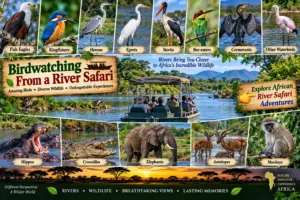
River safaris are excellent for bird photography because wildlife often concentrates around water.
Rather than moving quickly through a landscape, boats may provide opportunities to watch shorelines, exposed branches, islands, reeds, and trees.
Possible sightings can include:
- Fish eagles
- Kingfishers
- Herons
- Egrets
- Storks
- Bee-eaters
- Cormorants
- Other waterbirds
Rivers can also provide encounters with hippos, crocodiles, elephants, antelope, and monkeys along the banks.
Explore African River Safari Adventures
Bird & Monkey Watching From the Ground
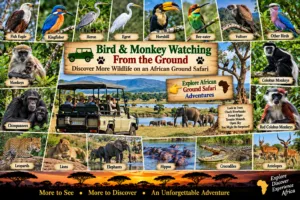
Ground safaris remain one of the easiest ways to experience a broad range of African wildlife.
Safari vehicles can cover considerable distances while allowing travelers to explore different habitats throughout the day.
When the vehicle stops, look beyond the obvious animals.
Check:
- High tree branches
- Dead trees
- Riverbanks
- Forest edges
- Termite mounds
- Open sky
- Areas around water
- Moving branches in the canopy
You may discover that an area that initially appeared empty contains numerous birds and smaller animals.
? Explore African Ground Safari Adventures
Wildlife From Above

Aerial safaris provide a completely different perspective.
Although individual birds and monkeys generally are not the primary focus of an aerial safari, flying above Africa can reveal the habitats supporting them.
From above, travelers can appreciate the relationship between:
- Rivers
- Forests
- Wetlands
- Savannas
- Lakes
- Mountains
- Coastlines
- Wildlife corridors
It becomes easier to understand why particular animals concentrate around certain environments.
Explore African Aerial Safari Adventures
Camper Safaris & Birdwatching
Traveling by camper can create excellent opportunities for bird enthusiasts.
Early morning is often one of the most active times for birdlife, and staying near natural environments can allow travelers to hear the landscape awakening before beginning the day’s drive.
A camper safari may also allow more time to explore slowly instead of rushing between major wildlife attractions.
Never leave food available to monkeys or other animals around campsites.
Explore African Camper Safari Adventures
Photographing African Birds
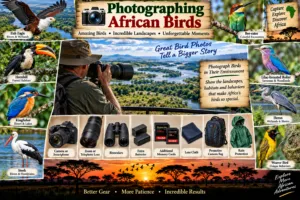
Bird photography can be more challenging than photographing many large mammals.
Birds are smaller, frequently farther away, and can move suddenly.
Useful equipment may include:
- Camera or smartphone
- Zoom or telephoto lens
- Binoculars
- Extra batteries
- Additional memory cards
- Lens cloth
- Protective camera bag
- Lightweight rain protection
Try photographing birds in their environment rather than concentrating exclusively on extreme close-ups.
An eagle perched above an African river or a hornbill surrounded by woodland can tell a much larger story than the animal alone.
Photographing Monkeys & Primates
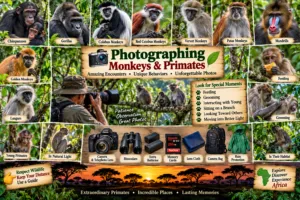
Primates create different photographic challenges because they may constantly move between branches.
Watch for moments when an animal:
- Stops to feed
- Looks toward another troop member
- Grooms another monkey
- Sits on an exposed branch
- Interacts with its young
- Moves into better natural light
Avoid approaching wildlife simply to obtain a better photograph.
A longer lens or careful positioning with a qualified guide is preferable to disturbing an animal.
Best Times of Day
Early morning and late afternoon can be particularly rewarding for wildlife observation.
Morning can provide:
- Active birdlife
- Cooler temperatures
- Softer photography light
- Increased animal movement
Late afternoon can offer:
- Golden light
- Raptors returning to perches
- Wildlife approaching water
- Dramatic landscapes
Forest wildlife can be less predictable because dense canopy affects both visibility and lighting throughout the day.
Best Time for an African Bird & Primate Safari
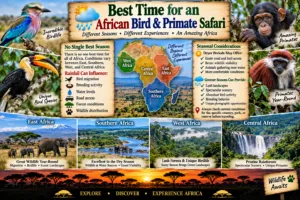
There is no single best season for all of Africa.
Conditions differ considerably between East, Southern, West, and Central Africa.
Rainfall can transform landscapes and influence:
- Bird migration
- Breeding activity
- Water levels
- Road access
- Forest conditions
- Wildlife distribution
Dryer periods may make some roads and trails easier to navigate, while greener seasons can produce spectacular landscapes and abundant bird activity.
Always check current conditions for the specific country, park, or reserve before traveling.
What to Bring
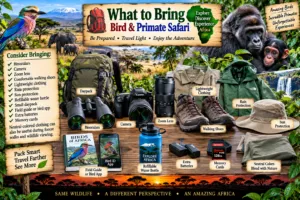
A bird and primate safari does not require enormous amounts of specialized equipment, but several items can make the experience much more enjoyable.
Consider bringing:
- Binoculars
- Camera
- Zoom lens
- Comfortable walking shoes
- Lightweight clothing
- Rain protection
- Sun protection
- Refillable water bottle
- Small daypack
- Field guide or bird identification app
- Extra batteries
- Memory cards
Neutral-colored clothing can also be useful during forest walks and wildlife viewing.
Lodges, Camps & Forest Stays

Accommodation can become part of the wildlife experience.
Depending on the destination, travelers may choose:
- Safari lodges
- Tented camps
- Riverside camps
- Forest lodges
- Eco-lodges
- National park accommodations
- Camper sites
A forest lodge may provide opportunities to hear monkeys and birds directly from the property, while a riverside camp can be excellent for watching waterbirds and listening for wildlife around the river.
Choosing accommodation close to the habitats you want to explore can reduce travel time and provide additional wildlife opportunities.
Book Your African Safari Stay
Planning an African bird, primate, or wildlife safari often means staying close to national parks, forests, rivers, and major safari destinations. Whether your adventure takes you to Kenya, Tanzania, Uganda, or another part of Africa, finding the right lodge, hotel, or nearby accommodation can make exploring much easier.
Compare available accommodations, locations, guest reviews, and travel dates before choosing the stay that works best for your safari itinerary.
👉Book Your African Safari Stay with Expedia
Sample 14-Day Birds, Eagles & Primates Safari
A longer itinerary could combine several different types of African wildlife experiences.
Days 1–4 — Savanna Safari
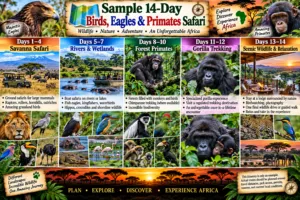
Begin with ground safaris focused on large mammals, raptors, rollers, hornbills, ostriches, and other grassland birds.
Days 5–7 — Rivers & Wetlands
Explore rivers or lakes by boat while watching for fish eagles, kingfishers, waterbirds, hippos, crocodiles, and wildlife visiting the shoreline.
Days 8–10 — Forest Primates
Travel into a forest environment for monkeys, birds, and—where appropriate—chimpanzee trekking.
Days 11–12 — Gorilla Trekking
Add a specialized gorilla experience in a destination where regulated trekking is available.
Days 13–14 — Scenic Wildlife & Relaxation
Finish at a lodge surrounded by nature, allowing time for birdwatching, photography, and one final wildlife drive or guided walk.
This itinerary is only an example. Actual routes should be planned around travel distances, park access, permits, seasons, and current local conditions.
Combine Birds, Eagles & Monkeys With a Complete African Safari

One of the best things about African wildlife travel is that you do not have to choose only one type of adventure.
Combine:
Ground Safari — Lions, elephants, giraffes, antelope, monkeys, and birds.
River Safari — Fish eagles, kingfishers, hippos, crocodiles, elephants, and waterbirds.
Aerial Safari — See the enormous landscapes and habitats supporting Africa’s wildlife.
Camper Safari — Travel slowly and experience wildlife from multiple regions and environments.
Gorilla Trekking — Enter Africa’s forests for one of the continent’s most extraordinary primate encounters.
Bird & Primate Safari — Look beyond the Big Five and discover the wildlife living in the trees, forests, wetlands, and skies.
Together, these experiences reveal just how diverse an African safari can be.
Explore More African Safari Adventures
Africa is much more than a single safari experience.
A lion walking across the savanna may be unforgettable, but so can an African fish eagle calling above a river, a brilliantly colored roller perched beside a safari trail, monkeys moving through the forest canopy, or a gorilla quietly resting among rainforest vegetation.
The more closely you look, the more wildlife Africa reveals.
By combining birds, eagles, monkeys, rivers, forests, ground safaris, aerial adventures, camper travel, and gorilla trekking, travelers can experience Africa from almost every perspective.
And sometimes the most memorable safari sighting isn’t walking across the ground.
Hiking Boots & Safari Footwear
Comfortable, dependable footwear can make a major difference when exploring Africa’s forests, trails, wildlife areas, and primate habitats. Sturdy hiking boots or trail shoes can provide better support and traction for uneven terrain, while lightweight and breathable options may be more comfortable in warmer conditions.
👉Explore the Ultimate Hiking Footwear Guide: Hiking Boots, Sandals & Sneakers
Explore More East Africa Safari Adventures
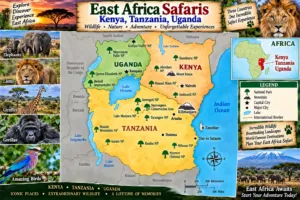
Continue your African wildlife journey across Kenya, Tanzania, and Uganda, where savannas, rivers, forests, lakes, birds, primates, and legendary wildlife destinations create countless opportunities for adventure.
👉Explore East Africa Safaris – Kenya, Tanzania, Uganda
Thank you for visiting MyCampingVacationSites! I hope this guide helps you plan an unforgettable outdoor adventure. If you enjoyed this article, feel free to leave a comment below and explore more travel guides, hiking destinations, camping adventures, and outdoor experiences throughout the site. Have a wonderful vacation wherever your next journey takes you!
— Jeffrey
 Explore More Hubs
 Water Adventure Gear
 50 Must-Have Water Adventure Items (Complete Gear Guide) Ultimate Jet Ski Gear & Accessories Guide
  (Top Picks for Speed & Fun) Best River Rafts & Floating Docks
  (Rafting & Floating Essentials)
 Camping & Tent Gear
Tents: Best Tents for Camping & Outdoor Adventures (Top-Rated Picks) Ultimate Glamping Gear: 50 Must-Have Tents & Adventure Essentials  (Luxury Setup Guide)
 RV & Camper Gear
RV Adventure Gear: Must-Have Essentials for Road Trips & Camping (Full Travel Setup) Ultimate Interior RV & Camper Gear Guide  (Comfort & Living Upgrades)
Leave a Reply