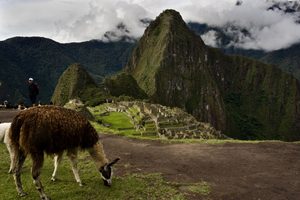
The dramatic mountains surrounding Machu Picchu and Peru’s Sacred Valley are famous for ancient Inca ruins, but the region also supports an impressive variety of wildlife. From elusive mountain cats and spectacled bears to colorful hummingbirds, soaring Andean condors, snakes, and high-altitude lizards, wildlife adds another dimension to exploring this remarkable part of Peru.
Thank you for reading this post, don't forget to subscribe!Different elevations create very different habitats. Travelers can move from dry Sacred Valley landscapes into cloud forests, mountain grasslands, rocky slopes, rivers, and humid forests surrounding Machu Picchu—each supporting its own collection of species.
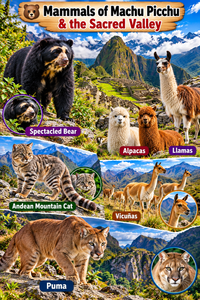
🐻 Mammals of Machu Picchu & the Sacred Valley
Spectacled Bear
The spectacled bear, also known as the Andean bear, is one of the most fascinating animals found in the region. It is South America’s only native bear species and inhabits portions of the cloud forests and mountainous terrain surrounding Machu Picchu.
These bears are generally shy and difficult to encounter. Their pale facial markings often form distinctive patterns around their eyes, giving the species its familiar name.
Travelers are much more likely to appreciate their habitat than actually encounter one, but knowing these bears inhabit the surrounding mountains makes hiking through the region even more interesting.
Andean Mountain Cats
The extraordinarily elusive Andean mountain cat inhabits high-elevation regions of the Andes. With grayish fur, dark markings, and a long banded tail, it is adapted to rocky mountain environments.
Seeing one in the wild is exceptionally unlikely. Travelers should therefore regard any sighting as extraordinary rather than something expected during a Machu Picchu vacation.
Puma
Pumas have a vast range across the Americas, including portions of the Andes. These powerful cats generally avoid people and inhabit remote mountainous landscapes.
Although hikers are unlikely to encounter one around heavily traveled archaeological areas, pumas are part of the broader Andean ecosystem.
Vicuñas, Alpacas & Llamas
Few animals symbolize Peru’s Andes more strongly than its camelids.
Vicuñas are wild relatives of llamas and alpacas and are famous for their exceptionally fine wool. They generally favor high Andean environments.
Alpacas are domesticated and commonly associated with Andean communities, while llamas have served as pack animals for centuries.
Around Cusco, the Sacred Valley, and popular archaeological destinations, travelers have plenty of opportunities to photograph llamas and alpacas.
🦅 Birds of Machu Picchu & the Andes
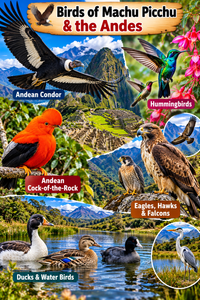
Birdwatching can be one of the most rewarding wildlife activities around Machu Picchu because the dramatic changes in elevation create numerous habitats.
Andean Condor
The Andean condor is among South America’s most recognizable birds. Its enormous wings allow it to soar efficiently on mountain air currents.
Condors shouldn’t be expected at every Machu Picchu overlook, but travelers exploring the broader Andes may have opportunities to observe these magnificent birds.
Hummingbirds
The cloud forests surrounding Machu Picchu support numerous hummingbirds. Their brilliant colors and rapid movements make them exciting subjects for wildlife photographers.
Gardens, flowering vegetation, forest edges, and quieter trails can provide opportunities for sightings.
Andean Cock-of-the-Rock
One of Peru’s most spectacular birds is the Andean cock-of-the-rock, famous for the male’s brilliant orange-red plumage and unusual crest.
It favors humid Andean forests and is particularly associated with cloud-forest environments.
Eagles, Hawks & Falcons
Travelers should also watch the skies and mountain ridges for birds of prey. Various raptors inhabit the Andes, where open valleys and mountain slopes provide hunting territory.
Ducks & Water Birds
The Sacred Valley’s rivers, wetlands, lakes, and streams create additional habitat for water birds. Travelers exploring beyond the major archaeological attractions can encounter an entirely different collection of birds near these environments.
🦎 Lizards of the Sacred Valley
Reptiles receive far less attention than Peru’s bears, condors, and llamas, but they are another part of the Andean ecosystem.
Small lizards can inhabit rocky slopes, stone walls, sunny clearings, and dry portions of the Sacred Valley. Because reptiles depend on external heat, sunny rocks provide valuable places for warming themselves.
Hikers should observe them without attempting to capture or handle them.
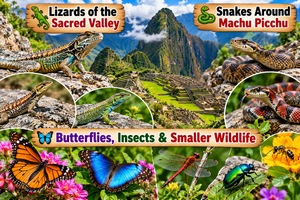
🐍 Snakes Around Machu Picchu
Snakes occur in Peru, although travelers shouldn’t assume that every trail around Machu Picchu is filled with dangerous snakes.
The cooler high-altitude environment limits many species compared with Peru’s warmer tropical lowlands. However, the warmer and more humid cloud forests at lower elevations provide better reptile habitat.
The sensible approach while hiking is simple: remain on established trails, watch where you place your hands and feet, avoid reaching blindly beneath rocks or vegetation, and never attempt to handle an unidentified snake.
🦋 Butterflies, Insects & Smaller Wildlife
Some of the easiest wildlife to overlook is also among the most colorful.
Cloud forests can support butterflies, moths, beetles, dragonflies, and many other insects. Flowers along trails also attract pollinators and hummingbirds.
These smaller creatures are particularly useful for travelers interested in macro photography.
🌿 Where to Look for Wildlife
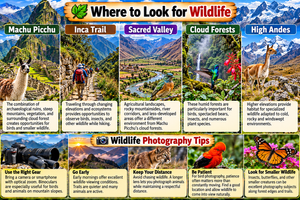
Machu Picchu: The combination of archaeological ruins, steep mountains, vegetation, and surrounding cloud forest creates opportunities for birds and smaller wildlife.
Inca Trail: Traveling through changing elevations and ecosystems provides opportunities to observe birds, insects, and other wildlife while hiking.
Sacred Valley: Agricultural landscapes, rocky mountainsides, river corridors, and less-developed areas offer a different environment from Machu Picchu’s cloud forests.
Cloud forests: These humid forests are particularly important for birds, spectacled bears, insects, and numerous plant species.
High Andes: Higher elevations provide habitat for specialized wildlife adapted to cold, rocky and windswept environments.
📸 Wildlife Photography Tips
Bring a camera or smartphone with optical zoom whenever possible. Binoculars are particularly useful for birds and animals positioned high on mountain slopes.
Early mornings can provide excellent wildlife-viewing conditions because trails may be quieter and many animals are active. Avoid chasing wildlife for photographs. A longer lens allows travelers to photograph animals while maintaining a respectful distance.
For bird photography, patience often matters more than constantly moving. Find a promising location near vegetation or a forest edge and allow wildlife to come into view naturally.
🥾 Wildlife Hiking Essentials
A wildlife-focused day around Machu Picchu or the Sacred Valley doesn’t require complicated equipment. Useful items include binoculars, a camera with a zoom lens, comfortable hiking shoes, lightweight rain protection, sun protection, water, and a small daypack.
Travelers exploring cloud forests should prepare for rapidly changing conditions. Sunshine, mist and rain can occur during the same excursion.
🏨 Where to Stay for Wildlife Adventures
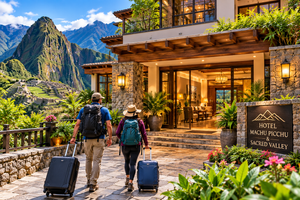
Cusco and the Sacred Valley provide excellent bases for exploring the region. Travelers interested primarily in Machu Picchu can also stay around Aguas Calientes, providing convenient access to the archaeological sanctuary and surrounding cloud-forest environment.
Sacred Valley accommodations can be especially attractive for travelers wanting quieter surroundings, mountain scenery, birdwatching, hiking and countryside experiences.
A wildlife itinerary can therefore combine Cusco → Sacred Valley → Machu Picchu, allowing travelers to experience several different environments rather than concentrating exclusively on the famous citadel.
🏨 Book Your Machu Picchu & Sacred Valley Stay
Turn your wildlife adventure into a complete Peru getaway by staying near Machu Picchu, Aguas Calientes, Cusco, or the Sacred Valley. These areas provide convenient bases for exploring ancient Inca sites, cloud forests, mountain trails, birdwatching areas, and the spectacular landscapes of the Peruvian Andes.
Whether you’re looking for a comfortable hotel in Cusco, a peaceful Sacred Valley retreat, or accommodations close to Machu Picchu, booking ahead can make it easier to plan transportation, hiking, sightseeing, and wildlife adventures.
👉 Search Hotels & Stays Near Machu Picchu & the Sacred Valley – Expedia
Affiliate Disclosure
Disclosure: This article may contain affiliate links. If you book a hotel, accommodation, or other travel service through one of these links, I may earn a commission at no additional cost to you. These commissions help support My Camping Vacation Sites and allow me to continue creating outdoor adventure and travel guides
🌎 Protecting Andean Wildlife
Wildlife encounters are best when animals remain wild. Keep a respectful distance, don’t feed animals, stay on designated trails where required, and carry out anything you bring into natural areas.
Supporting responsible guides, protected areas, and environmentally conscious accommodations can also help preserve the landscapes travelers have come to experience.
Final Thoughts
Machu Picchu may be the headline attraction, but the surrounding ecosystem makes the journey much richer. Spectacled bears, pumas, Andean wildlife, hummingbirds, condors, reptiles, butterflies, and countless smaller species inhabit the varied landscapes surrounding the Sacred Valley and Peruvian Andes.
For your Machu Picchu backbone, this gives you a strong wildlife-specific article that complements the Citadel, Ollantaytambo, Pisac and Humantay Lake articles without repeating them. It also gives you plenty of material later for wildlife, binoculars, cameras, hiking gear and animal-specific Pinterest pins.
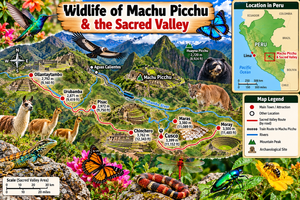
🐻 Wildlife of Machu Picchu & the Sacred Valley
Discover another side of Machu Picchu beyond its legendary Inca ruins. The surrounding cloud forests, mountain valleys, rocky slopes, rivers, and high Andes provide habitat for an impressive variety of wildlife.
Look for spectacled bears, pumas, Andean mountain cats, llamas, alpacas, vicuñas, Andean condors, hummingbirds, reptiles, butterflies, and other wildlife while exploring Machu Picchu and the Sacred Valley.
The guide also covers the best environments for wildlife viewing, birdwatching opportunities, photography tips, hiking essentials, and places to stay while exploring the region.
👉 Wildlife of Machu Picchu & the Sacred Valley
Thank you for visiting MyCampingVacationSites! I hope this guide helps you plan an unforgettable outdoor adventure. If you enjoyed this article, feel free to leave a comment below and explore more travel guides, hiking destinations, camping adventures, and outdoor experiences throughout the site. Have a wonderful vacation wherever your next journey takes you!
— Jeffrey
Leave a Reply