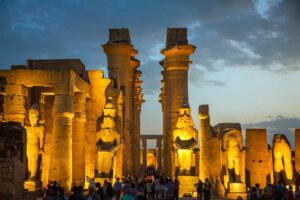
Luxor Temple – Heart of Ancient Thebes
Standing beside the Nile River in the heart of modern Luxor, Luxor Temple is one of Egypt’s most spectacular ancient landmarks. Massive columns, towering statues, beautifully carved walls, an ancient obelisk and the famous Avenue of Sphinxes tell the story of a sacred site that remained important for thousands of years.
Thank you for reading this post, don't forget to subscribe!Once part of ancient Thebes, Luxor Temple was closely connected with nearby Karnak Temple and played an important role in royal ceremonies and the ancient Egyptian Opet Festival. Today, visitors can walk through monumental gateways and courtyards while experiencing one of the most atmospheric archaeological sites in Egypt.
Unlike many ancient Egyptian temples constructed primarily for the worship of a particular deity, Luxor Temple was strongly associated with kingship, renewal and royal legitimacy.
And because the temple stands close to the Nile River, a visit to Luxor can easily become part of a larger adventure combining ancient temples, Nile cruises, traditional feluccas and the archaeological treasures of both the East and West Banks.
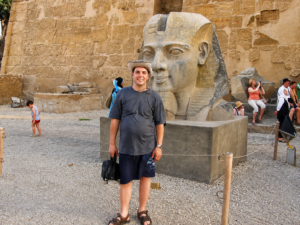
My Experience Among Luxor’s Ancient Monuments
During my vacation in Egypt, I had the opportunity to personally explore Luxor and its incredible ancient sites. Standing among the enormous statues, carved temple walls, towering columns, and hieroglyphics was an experience completely different from simply seeing these places in photographs.
What impressed me most was the enormous scale of the monuments. Standing beside these ancient statues gives you a much better appreciation for their size and for the incredible work that went into creating them thousands of years ago.
The photo is from my own visit to Luxor during my journey through Egypt. Being able to walk among these ancient monuments and see the details of the stonework up close was one of the experiences I remember most from the trip.
My journey through Luxor was also part of a larger adventure through Egypt before continuing along the Nile River toward Aswan. Seeing the temples and monuments firsthand made Luxor one of the most memorable destinations of my Egypt vacation.
👉Watch the Luxor Temple Video
Explore Luxor Temple through towering statues, ancient columns, hieroglyphics, sacred spaces and some of the most impressive architecture surviving from ancient Egypt.
Learn the History of Luxor Temple
Discover the fascinating history behind ancient Thebes and Luxor Temple, including how this remarkable complex developed and changed throughout the ages.
👉Watch: Luxor Temple (Explained) — The Ancient Temple of Thebes
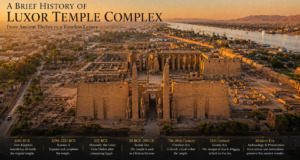
A Brief History of Luxor Temple
Construction of Luxor Temple took place over centuries, with several Egyptian rulers contributing to the complex.
Much of the temple was built during the reign of Amenhotep III, one of the great pharaohs of Egypt’s 18th Dynasty. Later rulers modified and expanded portions of the complex.
Tutankhamun and Horemheb contributed decorations, while Ramses II dramatically expanded the temple with a huge entrance pylon, courtyard and colossal statues.
The result is an extraordinary archaeological site where visitors can see evidence from different periods of Egyptian history within the same complex.

The First Pylon and Colossal Statues of Ramses II
One of the first things visitors encounters is the enormous entrance constructed during the reign of Ramses II.
The monumental pylon once formed a dramatic ceremonial gateway into the temple.
In front of it stand colossal statues representing Ramses II. These enormous stone figures immediately communicate the scale and power associated with Egypt’s pharaohs.
Walking between these statues and entering the temple is one of the most memorable experiences in Luxor.
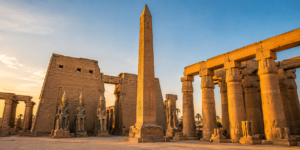
The Luxor Temple Obelisk
A towering ancient Egyptian obelisk still stands in front of Luxor Temple.
Originally, two obelisks stood at the entrance.
The surviving obelisk remains in Luxor, while its companion was transported to France during the 19th century and today stands in the Place de la Concorde in Paris.
Seeing the remaining obelisk beside the enormous temple entrance provides an excellent sense of the monumental architecture that once dominated ancient Thebes.
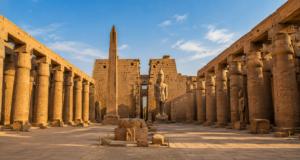
The Great Court of Ramses II
Beyond the entrance lies the impressive Court of Ramses II.
Massive columns surround the courtyard, accompanied by statues and carved stone surfaces.
Visitors walking through this section can appreciate how Egyptian architects used scale, symmetry and monumental sculpture to create ceremonial spaces designed to impress anyone entering the temple.
Look closely at the walls and columns because many still preserve ancient carvings and inscriptions.

The Grand Colonnade of Amenhotep III
One of Luxor Temple’s most impressive architectural features is its magnificent colonnade.
Towering columns create a dramatic passage through the temple complex.
Walking between these enormous columns provides one of the best opportunities to appreciate the extraordinary engineering abilities of ancient Egyptian builders.
Sunlight filtering between the columns also makes this one of the temple’s most photogenic areas.
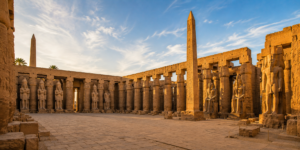
☀️ The Court of Amenhotep III
Beyond the colonnade is another impressive open courtyard associated with Amenhotep III.
Rows of columns surround the space, creating another striking example of New Kingdom architecture.
The courtyard provides a quieter transition between the monumental public portions of Luxor Temple and the increasingly sacred areas deeper within the complex.

✨ The Sanctuary and Sacred Areas
As visitors continue deeper into Luxor Temple, the spaces become smaller and more intimate.
These inner portions of the complex were associated with religious ceremonies and sacred rituals.
Priests and pharaohs would have participated in ceremonies honoring Amun and other members of the Theban divine family.
Standing inside these ancient chambers offers a completely different experience from the huge pylons and open courtyards near the temple entrance.

Hieroglyphics, Carvings and Ancient Wall Reliefs
Don’t rush through Luxor Temple.
Some of its most fascinating details can be found directly on the walls, columns and stone surfaces.
Look for representations of pharaohs, gods, ceremonial processions and ancient Egyptian inscriptions.
Thousands of years of weathering have affected the temple, yet many carvings remain remarkably detailed.
These smaller features are also excellent subjects for photography.

Walk the Avenue of Sphinxes
One of the most fascinating features of Luxor is the Avenue of Sphinxes, the ancient ceremonial route connecting Luxor Temple with Karnak Temple.
The avenue stretches for roughly 2.7 kilometers and was used during important religious processions, including celebrations associated with the Opet Festival.
Rows of sphinx statues once lined the route, creating an extraordinary ceremonial pathway through ancient Thebes.
Today, the restored avenue provides visitors with a powerful visual connection between two of Egypt’s greatest temple complexes.
? Continue your journey at Karnak Temple – Luxor, Egypt: Gateway to Ancient Wonders
Add your Karnak article link here.
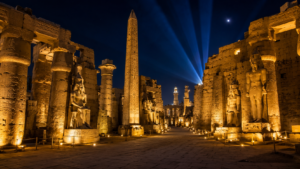
Experience Luxor Temple at Night
Luxor Temple is particularly beautiful after sunset.
Artificial lighting illuminates the massive columns, statues, carvings and sandstone walls, creating an entirely different atmosphere from a daytime visit.
The contrast between the golden temple and dark Egyptian night sky can be spectacular.
For photographers, visiting around sunset provides an opportunity to experience both daylight and nighttime views during the same visit.
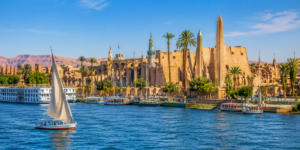
The Nile River and Luxor Temple
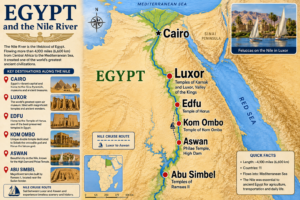
The Nile River is an essential part of the Luxor experience.
Luxor developed beside the Nile because the river provided transportation, agriculture, trade and life to ancient Egyptian civilization.
Today, visitors can still experience that relationship between the river and the ancient city.
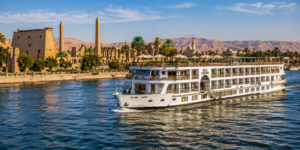
From the Luxor waterfront you may see large Nile cruise ships, traditional feluccas sailing across the water, palm-lined riverbanks and the desert mountains of the West Bank rising beyond the Nile.
Taking time to experience the river adds another dimension to a visit focused on temples and archaeological sites.
Take a Nile River Cruise from Luxor
Luxor is one of the most popular starting or stopping points for Nile River cruises.
Cruising the Nile provides a completely different perspective on Egypt.
Instead of simply traveling from attraction to attraction by road, passengers can watch the landscape slowly change from the deck of a ship.
Palm trees and agricultural fields line portions of the river while desert landscapes rise beyond the narrow green corridor created by the Nile.
Along the journey, travelers can encounter ancient temples, riverside communities, traditional boats and scenes of everyday life along one of the world’s most famous rivers.
👉Watch the Nile River Cruise – Egypt Video
Take a visual journey along the Nile featuring cruise ships, traditional feluccas, Luxor scenery, temples, villages, palm-lined riverbanks, desert landscapes and spectacular sunsets.
Add your new Nile River Cruise YouTube link here.
Explore the complete Nile River Cruise article
Add your Nile River Cruise article link here.
⛵ Sail the Nile on a Traditional Felucca
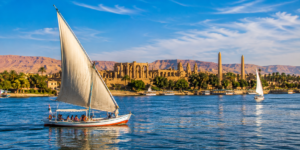
A Nile cruise doesn’t have to involve a large ship.
Traditional feluccas offer a quieter way to experience the river.
These distinctive sailing boats have traveled the Nile for generations.
A short felucca trip around Luxor can be especially enjoyable near sunset when temperatures begin cooling and the evening light reflects across the river.

The East Bank and West Bank of Luxor
The Nile divides many of Luxor’s most famous attractions between two areas.
The East Bank contains Luxor Temple, Karnak Temple, museums, hotels, restaurants and much of modern Luxor.
Across the Nile, the West Bank contains an extraordinary concentration of ancient burial sites and monuments.
This makes Luxor an excellent base for exploring several days rather than simply visiting one temple.
More Incredible Places to Explore Around

Luxor
Karnak Temple
Located north of Luxor Temple, Karnak is an enormous religious complex famous for its Great Hypostyle Hall, towering columns, obelisks, statues, sacred lake and monumental gateways.
The Avenue of Sphinxes historically connected Karnak and Luxor Temple.
Valley of the Kings
Across the Nile lies one of Egypt’s most famous archaeological areas.
The Valley of the Kings contains tombs constructed for New Kingdom pharaohs, including the famous tomb of Tutankhamun.
Temple of Hatshepsut
Built against dramatic desert cliffs at Deir el-Bahari, the Mortuary Temple of Hatshepsut is one of the most distinctive architectural sites around Luxor.
Valley of the Queens
This ancient burial area contains tombs associated with queens, royal children and other members of Egypt’s royal families.
Luxor Museum
Travelers interested in archaeology can add the Luxor Museum to their itinerary to see artifacts discovered throughout the region.
Where to Stay in Luxor
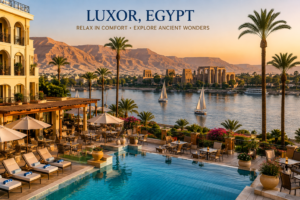
Staying in Luxor for several nights makes it much easier to experience the temples without rushing.
The East Bank offers convenient access to Luxor Temple, Karnak Temple, restaurants, shops and the Nile waterfront.
Travelers interested in quieter surroundings may also consider accommodations on the West Bank, where the landscape becomes more rural and many archaeological attractions are nearby.
👉Find hotels and places to stay in Luxor
Place your Expedia/booking link and lodging cards here.
Best Time to Visit Luxor
Luxor has a hot desert climate, so the time of year can significantly affect your experience.
October through April generally brings more comfortable temperatures for exploring outdoor archaeological sites.
Summer can be extremely hot, particularly during the middle of the day.
Regardless of season, early morning and late afternoon are often excellent times for exploring.
For Luxor Temple specifically, consider arriving in the late afternoon, experiencing the temple during daylight, watching the colors change around sunset and then seeing the illuminated complex after dark.

Photography at Luxor Temple
Luxor Temple offers outstanding photography opportunities.
Try capturing:
- The enormous Ramses II statues
- Luxor’s remaining obelisk
- Rows of ancient columns
- Hieroglyphics and carved reliefs
- The Avenue of Sphinxes
- Sunset light on the sandstone
- Illuminated columns after dark
- Nile River scenery
- Feluccas sailing at sunset
A combination of wide views and close-up details can tell the complete visual story of the temple.

What to Bring to Luxor Temple
Comfortable walking shoes are important because you’ll spend considerable time walking across stone and uneven surfaces.
Bring sun protection, sunglasses, a hat, lightweight clothing and plenty of water, especially during warmer months.
A camera or smartphone is essential if you enjoy travel photography.
A small daypack can also be useful for carrying water, camera equipment and other essentials while exploring Luxor.
❓ Luxor Temple FAQ
Is Luxor Temple worth visiting?
Absolutely. Its enormous statues, columns, obelisk, hieroglyphics, history and nighttime illumination make it one of the essential archaeological attractions in Luxor.
Is Luxor Temple the same as Karnak Temple?
No. They are separate temple complexes, although the ancient Avenue of Sphinxes connects them.
Can you visit Luxor Temple at night?
Luxor Temple is famous for its nighttime illumination. Check current opening hours locally before planning an evening visit because schedules can change.
How much time should I spend at Luxor Temple?
Many visitors can explore the major highlights in approximately 1–2 hours, although travelers interested in archaeology and photography may want longer.
Should I visit Karnak and Luxor Temple on the same day?
They work extremely well together because they tell interconnected parts of ancient Thebes’ history.
Why Luxor Temple Belongs on an Egypt Adventure
Luxor Temple is much more than a collection of ancient ruins.
It represents thousands of years of Egyptian history, architecture, religion and royal tradition, while its location beside the Nile connects today’s travelers with the river that helped make ancient Egyptian civilization possible.
Walk beneath towering columns. Stand beside colossal statues of Ramses II. Follow the Avenue of Sphinxes toward Karnak. Watch traditional feluccas cross the Nile. Explore the archaeological treasures of the West Bank. Then return to Luxor Temple after sunset and watch the ancient sandstone glow beneath the night sky.
Few destinations combine ancient history and living landscapes quite like Luxor.
Whether Luxor is part of a larger Egypt adventure or a journey along the Nile, this remarkable city offers enough temples, tombs, river scenery and archaeological wonders to keep travelers exploring for days.
Thank you for visiting MyCampingVacationSites! I hope this guide helps you plan an unforgettable outdoor adventure. If you enjoyed this article, feel free to leave a comment below and explore more travel guides, hiking destinations, camping adventures, and outdoor experiences throughout the site. Have a wonderful vacation wherever your next journey takes you!
— Jeffrey
 Explore More Hubs
 Water Adventure Gear
 50 Must-Have Water Adventure Items (Complete Gear Guide) Ultimate Jet Ski Gear & Accessories Guide
  (Top Picks for Speed & Fun) Best River Rafts & Floating Docks
  (Rafting & Floating Essentials)
 Camping & Tent Gear
Tents: Best Tents for Camping & Outdoor Adventures (Top-Rated Picks) Ultimate Glamping Gear: 50 Must-Have Tents & Adventure Essentials  (Luxury Setup Guide)
 RV & Camper Gear
RV Adventure Gear: Must-Have Essentials for Road Trips & Camping (Full Travel Setup) Ultimate Interior RV & Camper Gear Guide  (Comfort & Living Upgrades)
 Glamping & Outdoor Living
Ultimate Camping & Glamping Gear (50 Must-Have Essentials for Outdoor Adventures)
Leave a Reply