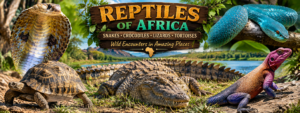
Africa’s wildlife is famous for lions, elephants, giraffes, gorillas, and other large animals, but another fascinating world is often hiding along riverbanks, beneath vegetation, across rocky landscapes, and within forests.
Thank you for reading this post, don't forget to subscribe!Crocodiles resting beside African rivers, snakes moving through grasslands, colorful chameleons clinging to branches, monitor lizards searching along waterways, and tortoises crossing dry landscapes can all add another dimension to an African safari.
Reptiles are an important part of Africa’s ecosystems. Some are powerful predators, while others feed on insects, plants, fish, eggs, or smaller animals.
For travelers interested in wildlife photography and biodiversity, discovering Africa’s reptiles can turn an ordinary wildlife sighting into one of the most memorable moments of the journey.
🐊 Nile Crocodiles – Giants of Africa’s Rivers
Few reptiles symbolize an African river safari as strongly as the Nile crocodile.
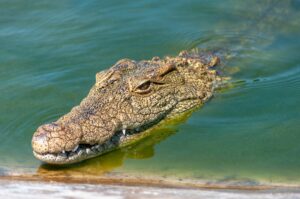
These formidable predators inhabit rivers, lakes, wetlands, and other freshwater environments across much of sub-Saharan Africa. Travelers may see them resting motionless along muddy riverbanks or partially submerged with little more than their eyes and nostrils visible above the water.
Excellent safari environments for crocodile sightings include areas around:
- The Nile and Victoria Nile
- Chobe River
- Zambezi River
- Okavango region
- Rufiji River
- Kazinga Channel
- Lakes and wetlands throughout East and Southern Africa
A boat safari can provide particularly interesting views because visitors experience the crocodile’s habitat from the water.
Always maintain appropriate distances and follow instructions from guides and park authorities.
🚤 Crocodiles on an African River Safari
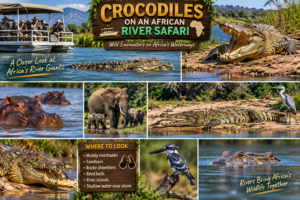
River safaris provide an entirely different perspective from traditional game drives.
From a safari boat, travelers may encounter crocodiles resting along exposed banks while hippos occupy deeper pools, elephants approach the shoreline, and birds gather around wetlands.
Crocodiles can remain remarkably still, making careful observation important.
Look around:
- Muddy riverbanks
- Sandbars
- Rocky shorelines
- Reed beds
- River islands
- Shallow water near shore
Binoculars or a zoom lens allow travelers to observe these animals without getting unnecessarily close.
🐍 Snakes of the African Savanna
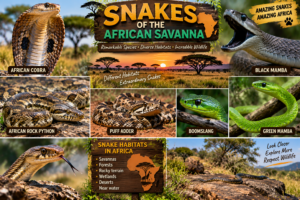
Africa supports an extraordinary variety of snakes.
Some inhabit open savannas, while others prefer forests, rocky terrain, wetlands, deserts, or areas close to water.
Among Africa’s better-known snakes are:
- African rock python
- Black mamba
- Puff adder
- Boomslang
- Cobras
- Green mambas
Despite their reputation, snakes are not necessarily easy to see on safari. Many rely on camouflage and spend much of their time hidden from view.
A guide who understands local habitats may notice snakes that travelers would otherwise walk directly past without ever seeing.
🐍 African Rock Pythons

The African rock python is among Africa’s most impressive snakes.
Unlike venomous species, pythons subdue prey through constriction. Their patterned coloration also provides effective camouflage among vegetation, rocks, and woodland environments.
They may be associated with habitats near:
- Rivers
- Wetlands
- Savannas
- Forest edges
- Rocky landscapes
Seeing a large python in its natural environment can be an extraordinary safari encounter, but travelers should never approach or disturb one.
⚠️ Black Mambas, Cobras & Other Venomous Snakes
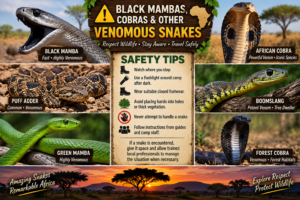
Africa is home to several highly venomous snake species, including black mambas and different cobras.
This does not mean travelers should expect dangerous encounters around every corner.
Most safari visitors will spend their trip traveling with experienced guides, using established trails, staying in managed camps or lodges, and observing wildlife from appropriate distances.
Simple precautions are valuable:
- Watch where you step.
- Use a flashlight around camp after dark.
- Wear suitable closed footwear.
- Avoid placing hands into holes or thick vegetation.
- Never attempt to handle a snake.
- Follow instructions from guides and camp staff.
If a snake is encountered, give it space and allow trained local professionals to manage the situation when necessary.
🦎 Monitor Lizards

Monitor lizards are another exciting reptile to watch for during an African safari.
The Nile monitor is particularly associated with aquatic environments and can be seen near rivers, lakes, wetlands, and surrounding vegetation.
These large lizards are strong swimmers and opportunistic feeders.
Travelers exploring river environments may occasionally see one moving along a shoreline, climbing through vegetation, swimming across water, or resting in the sun.
Their size can make them one of the more noticeable reptiles on safari.
🦎 Chameleons – Small Wildlife With Incredible Colors
Not every memorable safari animal needs to be enormous.
Chameleons can provide some of the most interesting close-up wildlife encounters in Africa.
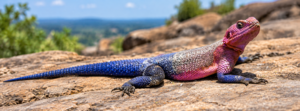
Their unusual eyes, gripping feet, long tongues, and ability to alter coloration make them fascinating photography subjects.
Depending on the region, chameleons may occur in:
- Forests
- Woodlands
- Shrublands
- Mountain environments
- Gardens around some lodges
Because they can blend remarkably well with surrounding vegetation, an experienced guide may be invaluable for spotting them.
🐢 Tortoises & Other Reptiles
Africa’s reptile diversity extends far beyond crocodiles, snakes, monitors, and chameleons.
Depending on the destination, travelers may encounter different:
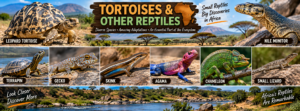
- Tortoises
- Terrapins
- Geckos
- Skinks
- Agamas
- Small lizards
These smaller animals are easily overlooked when everyone is searching for elephants and big cats.
Taking time to examine rocky areas, trees, wetlands, and vegetation can reveal an entirely different layer of the safari ecosystem.
🌳 Rainforest Reptiles of West & Central Africa

The rainforests and river systems of West and Central Africa create another environment for reptile enthusiasts.
Dense vegetation, wetlands, lagoons, rivers, and humid forests support snakes, lizards, turtles, crocodilians, and many smaller species.
Countries such as Gabon can combine reptile watching with encounters involving forest elephants, primates, birds, and other rainforest wildlife.
These environments are especially interesting because wildlife can appear very differently from the open savannas commonly associated with African safaris.
🌊 Reptiles of East Africa
East Africa offers an enormous variety of habitats.
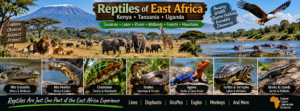
Travelers exploring Kenya, Tanzania, and Uganda can move between savannas, lakes, rivers, wetlands, forests, and mountain environments.
That variety creates opportunities to combine reptile watching with classic safari experiences involving:
🦁 Lions
🐘 Elephants
🦒 Giraffes
🦅 Eagles
🐒 Monkeys
🐊 Crocodiles
🐍 Snakes
River and wetland environments can be particularly rewarding when searching for crocodiles and monitor lizards.
🌅 Reptiles of Southern Africa
Southern Africa adds deserts, river systems, wetlands, savannas, rocky environments, and extensive national parks to the safari experience.
Destinations such as the Okavango region, Chobe, Kruger, Zambezi region, Etosha, and surrounding wilderness areas provide opportunities to encounter reptiles alongside Africa’s better-known mammals and birds.
During warmer conditions, reptiles may become especially noticeable as they bask or become more active.
📸 Reptile & Crocodile Photography
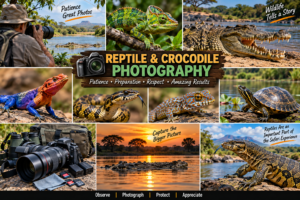
Photographing reptiles requires patience.
A crocodile may remain motionless for long periods, while a small lizard or snake can disappear into vegetation almost instantly.
Useful equipment can include:
- Camera or smartphone
- Zoom lens
- Extra batteries
- Additional memory cards
- Binoculars
- Lens cloth
- Protective camera bag
For crocodiles and snakes, a zoom lens is far more useful than moving closer.
Try photographing reptiles within their environment rather than concentrating exclusively on tight portraits. A crocodile surrounded by an African river landscape can tell a much stronger safari story.
👀 Look Beyond Africa’s Big Five
It is easy to spend an entire safari searching for lions, elephants, leopards, rhinos, and buffalo.
But some of the most rewarding discoveries happen when travelers begin looking beyond the largest animals.
A chameleon hidden on a branch, a monitor lizard swimming across a river, an eagle watching a crocodile from above, or a python disappearing into vegetation can become just as memorable.
The more carefully you observe an ecosystem, the more wildlife you begin to notice.
🥾 What to Bring for Reptile & Wildlife Watching
A few basic items can make wildlife exploration more comfortable.
Consider packing:
🥾 Sturdy hiking boots or walking shoes
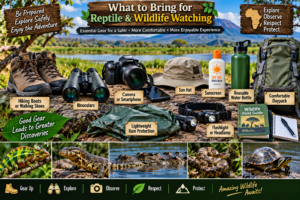
🔭 Binoculars
📸 Camera or smartphone
🧢 Sun hat
🧴 Sunscreen
💧 Reusable water bottle
🎒 Comfortable daypack
🌧️ Lightweight rain protection
🔦 Flashlight or headlamp
Closed footwear is particularly useful when walking through natural areas.
🏕️ Reptiles Around Safari Camps
Safari camps place travelers remarkably close to natural environments.
That is part of their appeal, but it also means small wildlife may occasionally appear around camp.
Geckos, lizards, frogs, insects, and sometimes snakes can occur in wilderness settings.
Keep tents or room doors properly secured, avoid leaving footwear outside without checking it, use a flashlight after dark, and follow the camp’s wildlife instructions.
Never attempt to catch, move, or feed wild reptiles.
🗓️ Best Time to See African Reptiles
Reptile activity depends heavily on temperature, rainfall, habitat, species, and destination.
Warm conditions can increase activity for many species, while water levels and seasonal rainfall influence river and wetland habitats.
Crocodiles may be visible throughout much of the year in suitable environments.
Because Africa covers an enormous range of climates, there is no single best reptile season for the entire continent.
Check current conditions for the specific parks and countries included in your itinerary.
🏨 Plan & Book Your African Safari
Ready to experience Africa’s wildlife for yourself? From river safaris and game drives to rainforest adventures and reptile watching, choosing the right place to stay can put you closer to the landscapes and wildlife you came to explore.
👉 Book Your African Safari Stay
Compare hotels, lodges, resorts, and other accommodations near some of Africa’s most exciting safari destinations.
🚙 Combine Reptile Watching With a Complete African Safari

One of the best approaches is to make reptiles part of a much larger wildlife adventure.
Combine:
🚙 Ground Safari — Search for lions, elephants, giraffes, antelope, snakes, lizards, and other wildlife.
🚤 River Safari — Watch for crocodiles, monitor lizards, hippos, elephants, and waterbirds.
🎈 Aerial Safari — Experience Africa’s rivers, wetlands, forests, and savannas from above.
🦍 Gorilla Trekking — Explore rainforest ecosystems filled with primates, birds, reptiles, and other wildlife.
🏕️ Camper Safari — Spend more time surrounded by the landscapes and sounds of the African wilderness.
🦅 Birds, Eagles & Monkeys — Add another layer of wildlife watching beyond the traditional safari favorites.
Together, these different experiences reveal how diverse an African safari can really be.
🗺️ Build Your African Safari Route
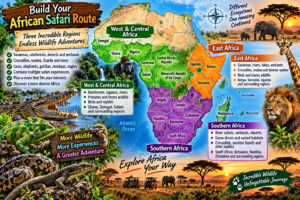
Instead of traveling to Africa for only one type of wildlife experience, consider building a route around several ecosystems.
An itinerary might combine:
East Africa — Savannas, rivers, lakes, wetlands, crocodiles, snakes, birds, and classic wildlife.
Southern Africa — River safaris, wetlands, deserts, game drives, crocodiles, monitors, and varied reptile habitats.
West & Central Africa — Rainforests, lagoons, rivers, primates, forest wildlife, birds, and reptiles.
Connecting several safari styles can transform one trip into a much broader exploration of African wildlife.
🐊 Final Thoughts – Discover Africa’s Reptile Wildlife
African Safari Reptiles, Snakes & Crocodiles reveal a side of safari travel that can easily be overlooked.
From enormous crocodiles resting beside rivers to brilliantly camouflaged snakes, colorful chameleons, powerful monitor lizards, and slow-moving tortoises, reptiles contribute enormously to Africa’s biodiversity.
The goal does not have to be finding the most dangerous or dramatic species.
The real reward is understanding how these animals fit into the same landscapes as Africa’s elephants, lions, gorillas, monkeys, eagles, and countless other species.
Take your time, keep your eyes open, respect wildlife from a safe distance, and allow Africa’s smaller and less celebrated animals to become part of the adventure.
The African wilderness becomes even more impressive when you start noticing everything that lives within it.
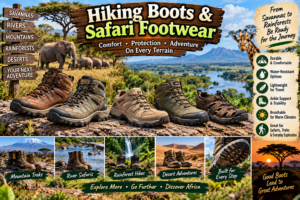
 Hiking Boots & Safari Footwear
 Hiking Boots & Safari Footwear
Comfortable, dependable footwear can make a major difference when exploring Africa’s forests, trails, wildlife areas, and primate habitats. Sturdy hiking boots or trail shoes can provide better support and traction for uneven terrain, while lightweight and breathable options may be more comfortable in warmer conditions.
 Explore the Ultimate Hiking Footwear Guide: Hiking Boots, Sandals & Sneakers
Explore More East Africa Safari Adventures
 Explore More East Africa Safari Adventures
Continue your African wildlife journey across Kenya, Tanzania, and Uganda, where savannas, rivers, forests, lakes, birds, primates, and legendary wildlife destinations create countless opportunities for adventure.
Explore East Africa Safaris – Kenya, Tanzania, Uganda
Thank you for visiting MyCampingVacationSites! I hope this guide helps you plan an unforgettable outdoor adventure. If you enjoyed this article, feel free to leave a comment below and explore more travel guides, hiking destinations, camping adventures, and outdoor experiences throughout the site. Have a wonderful vacation wherever your next journey takes you!
— Jeffrey
 Explore More Hubs
 Water Adventure Gear
50 Must-Have Water Adventure Items (Complete Gear Guide) Ultimate Jet Ski Gear & Accessories Guide  (Top Picks for Speed & Fun) Best River Rafts & Floating Docks
  (Rafting & Floating Essentials)
 Camping & Tent Gear
Tents: Best Tents for Camping & Outdoor Adventures (Top-Rated Picks) Ultimate Glamping Gear: 50 Must-Have Tents & Adventure Essentials  (Luxury Setup Guide)
 RV & Camper Gear
RV Adventure Gear: Must-Have Essentials for Road Trips & Camping (Full Travel Setup) Ultimate Interior RV & Camper Gear Guide  (Comfort & Living Upgrades)
Leave a Reply